

|
 ちょうせんごみし (朝鮮五味子) |
|
|
          |
|

|
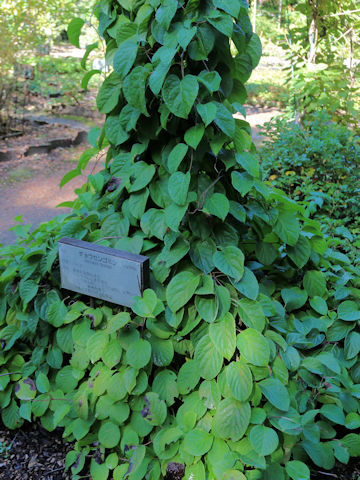
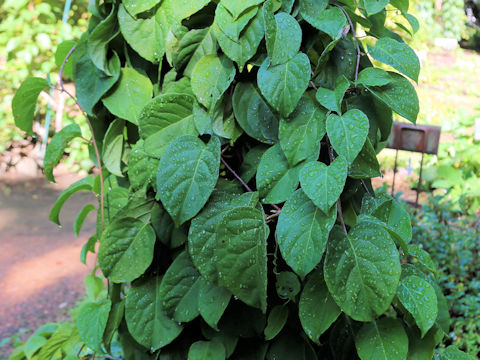
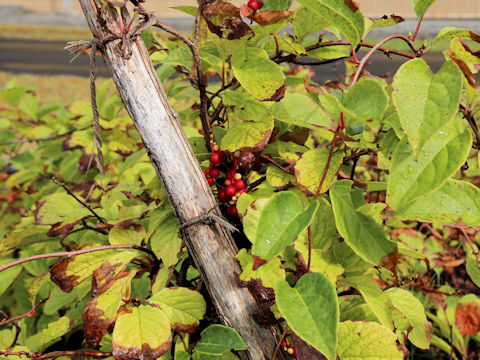
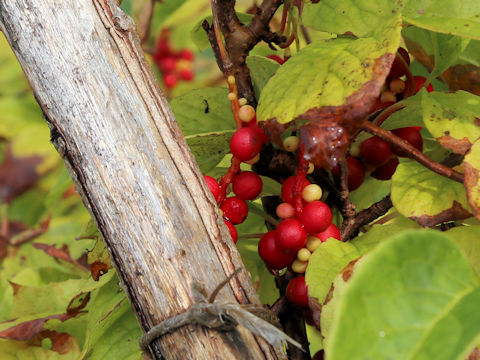
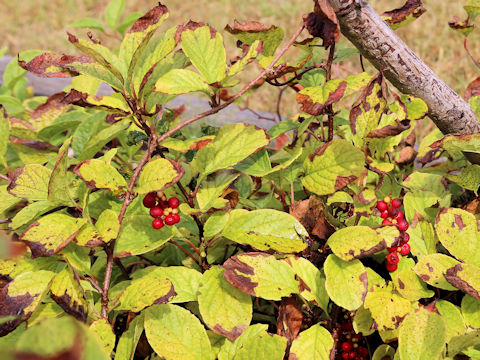
わが国の本州、中部地方以北から北海道、それに朝鮮半島や中国の東北部から北部・中部に分布しています。林床や林縁に生え、雌雄異株です。5月から6月ごろ、淡黄白色の花を咲かせます。またぶどうの房のような液果は、9月から10月ごろに赤く熟します。この果実は五味子(ごみし)と呼ばれ、漢方では鎮咳薬、去痰薬として用いられます。中国語では「五味子(wu wei zi)」と呼ばれます。 韓国語では「オミジャ(오미자)」です。1つの果実から「甘味・酸味・辛味・苦味・塩味」の5つの味(五味)がすることから名付けられました。韓国では、この果実を乾燥させて作った伝統茶である「オミジャ茶(오미자차)」が親しまれています。 |
|
|
マツブサ科マツブサ属の落葉蔓性木本で、学名は Schisandra chinensis。英名は Schisandra。 |
|
|
The Schisandra (Schisandra chinensis) belongs to the family Schisandraceae. It is a deciduous woody vine that is distributed northward from Chubu district to Hokkaido in Japan, as well as the Korean peninsula, and northeastern, northern, and central China. This vine grows in forest floors and edges. It is dioecious. The pale yellowish white flowers bloom from May to June. The racemose round berries ripen red in September to October. The fruits are called "Wu wei zi" and used as Chinese herbal medicine for antiussive or expectorant. It is called "五味子" (wu wei zi) in Chinese. In Korean, it's called "o-mi-ja" (오미자). It was named because a single fruit contains all five tastes: sweet, sour, spicy, bitter, and salty. In Korea, "Omija tea" (o-mi-ja-cha: 오미자차), a traditional tea made from dried omija fruit, is widely enjoyed. |
|
|
[上・中1] 長野県軽井沢町「軽井沢町植物園」にて、2010年07月24日撮影。 [中2] 長野県塩尻市「高ボッチ高原」にて、2005年09月21日撮影。 [中3・中4] 同上にて、2002年07月20日撮影。 [中5・中6] 北海道札幌市中央区「北海道大学植物園」にて、2026年09月30日撮影。 [中7~8・下] 北海道白老町若草町「ウポポイ」にて、2026年10月01日撮影。 |
|
|

|
Shu Suehiro shu@botanic.jp |