

|
 ちょうじそう (丁字草) |
|
|
                  |
|

|
わが国の北海道の南部から本州、四国・九州それに朝鮮半島、中国に分布しています。川岸などの湿った草地に生え、高さは40~80センチになります。葉は披針形で互生します。5月から6月ごろ、茎の先の集散花序に淡い青紫色の花を咲かせます。和名は、花冠が高坏形で筒部は細く、横から見ると丁の字に似ていることから。中国語では「水甘草(shui gan cao)」と呼ばれます。 韓国語では「チョンヒャンプル(정향풀)」です。これは「丁香(チョンヒャン: jeong-hyang: 정향)」+「草(プル: 풀)」の合成語です。「丁字」の果実や漢字の「丁」字に、花の形が似ていることから付けられた草という意味です。韓国では環境省によって絶滅危惧野生生物Ⅱ類に指定されています。 |
|
|
キョウチクトウ科チョウジソウ属の多年草で、学名は Amsonia elliptica。英名はありません。 |
|
|
The "Choji-so" (Amsonia elliptica) belongs to Apocynaceae (the Dogbane family). It is a perennial herb that is distributed southward from southern Hokkaido to Honshu, Shikoku and Kyushu in Japan, as well as the Korean Peninsula and China. This herb grows in the wet grasslands on stream banks, and can reach 40-80 cm in height. The leaves are lanceolate and alternate. The pale bluish purple flowers bloom in the terminal cymes from May to June. The Japanese name is derived from the tall, cup-shaped corolla with a narrow tubular part, which resembles the character for "丁" (ding) when viewed from the side. It is called "水甘草" (shui gan cao) in Chinese. In Korean, it's called "jeong-hyang-pul" (정향풀). This is a compound word consisting of "clove" (jeong-hyang: 정향) + "grass" (pul: 풀). The name refers to a plant whose flowers resemble the fruit of the "clove" or the Chinese character "丁". In South Korea, it has been designated as a Class Ⅱ Endangered Species by the Ministry of Environment. |
|
|
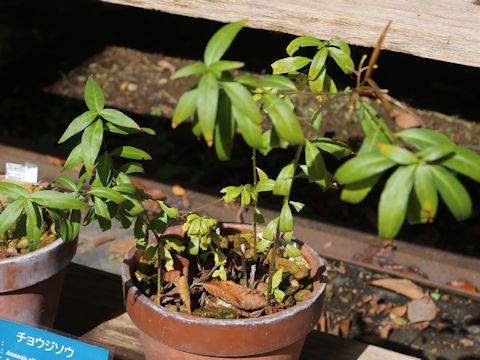
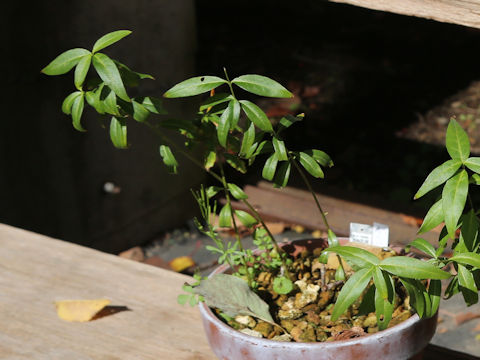
[上・中1] 茨城県つくば市「つくば実験植物園」にて、2009年05月23日撮影。 [中13~中15] 同上にて、2024年05月11日撮影。 [中2・中3] 京都府宇治市「宇治市植物公園」にて、2004年05月29日撮影。 [中4・中5] 大阪府四條畷市「むろいけ園地」にて、2012年05月30日撮影。 [中6・中7] 宮城県仙台市「東北大学植物園」にて、2016年05月14日撮影。 [中8~中12] 宮城県川崎町支倉にて、2020年05月15日撮影。 [中16・下] 北海道札幌市中央区「北海道大学植物園」にて、2026年09月30日撮影。 |
|
|

|
Shu Suehiro shu@botanic.jp |