
|

|
 たがねそう (鏨草) |
[Index]
[Back]
|
|
|
           |
|

|
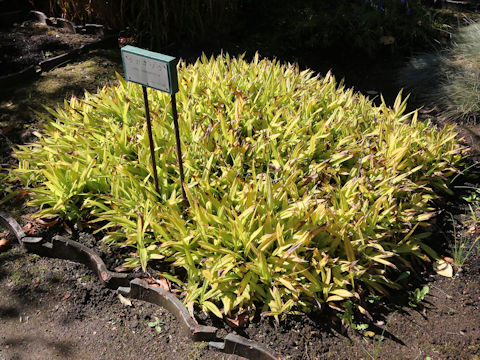
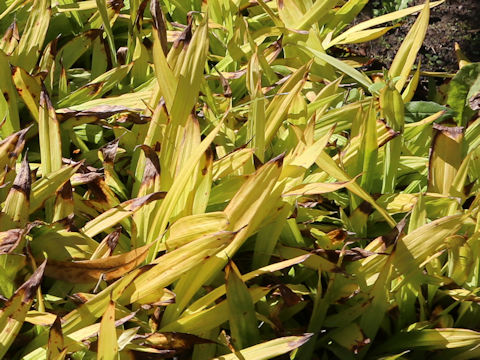
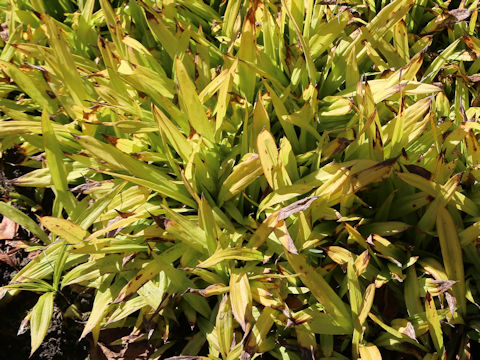
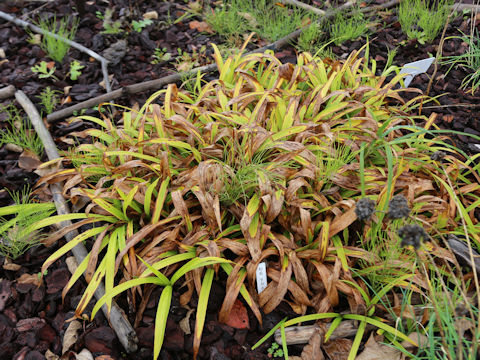
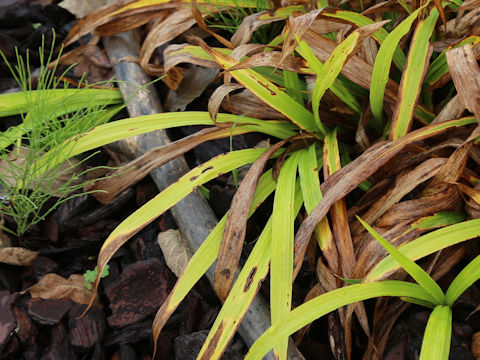
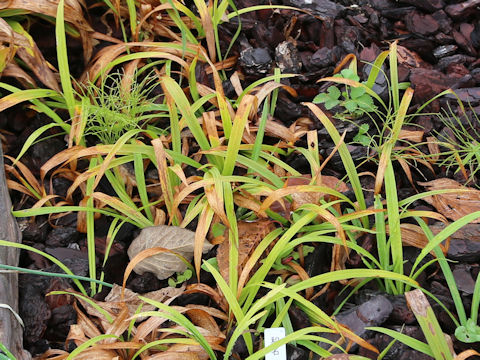
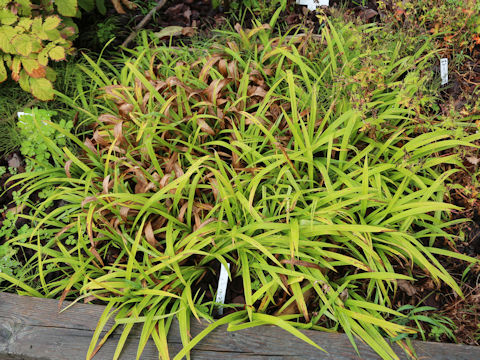
わが国の各地をはじめ、朝鮮半島や中国の北東部から中部、東部、極東ロシアに分布しています。山地の乾燥した林内や草地に生え、高さは10~40センチになります。根茎は匍匐してまばらに生えます。葉は披針形で幅1~3センチ、無毛またはまばらに毛があります。4月から5月ごろ、花茎を伸ばして、雌雄性の小穂を4~8個つけます。和名は、葉のかたちを鏨(たがね)に喩えたもの。中国語では「寬葉薹草(kuan ye tai cao)」と呼ばれます。 韓国語では「テサチョ(대사초)」です。これは「テ(대)」+「スゲ(サチョ: 사초)」の合成語です。「テ(대)」は「大きい」とか「竹」などを意味する言葉に由来し、一般的なスゲに比べて葉が幅広く、大きいという特徴から名付けられています。 |
|
|
カヤツリグサ科スゲ属の多年草で、学名は Carex siderosticta (syn. Carex siderosticta var. glabra)。英名はありません。 |
|
|
The "Tagane-so" (Carex siderosticta) belongs to Cyperaceae (the Sedge family). It is a perennial herb that is found throughout Japan, as well as on the Korean Peninsula, in northeastern, central, and eastern China, and in the Russian Far East. This herb grows in montane arid forests or grasslands and can reach 10-40 cm in height. The rhizomes are creeping and borne sparcely the shoots. The leaves are lanceolate 1-3 cm wide, glabrous or having a few hairs. It grows up the flowering stalks and bears 4-8 ambisexual spikes from April to May. The Japanese name comes from the resemblance of the leaves to a chisel. It is called "寬葉薹草" (kuan ye tai cao) in Chinese. In Korean, it's called "tyae-sa-cho" (대사초). This is a compound word consisting of "tyae" (대) + "sedge" (sa-cho: 사초). "tyae" (대) derives from words meaning "large" or "bamboo", and was named for its characteristic of having broader and larger leaves than typical sedges. |
|
|
[上・中1] 長野県阿智村智里「ヘブンスそのはら」にて、2007年05月08日撮影。 [中2・中3] 愛知県名古屋市千種区「東山動植物園」にて、2017年08月03日撮影。 [中4~中6] 北海道札幌市中央区「北海道大学植物園」にて、2026年09月30日撮影。 [中7~9・下] 北海道白老町若草町「ウポポイ」にて、2026年10月01日撮影。 |
|
|

|
Shu Suehiro shu@botanic.jp |
|