
|

|
 たかねくろすげ (高嶺黒菅) |
[Index]
[Back]
|
|
|
     |
|

|
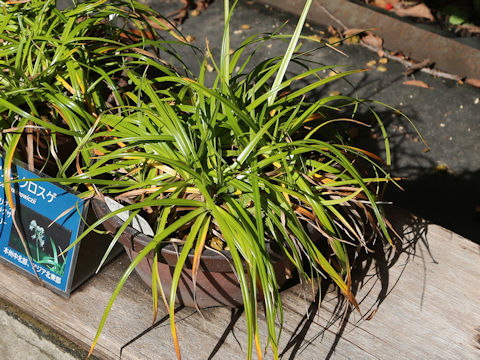
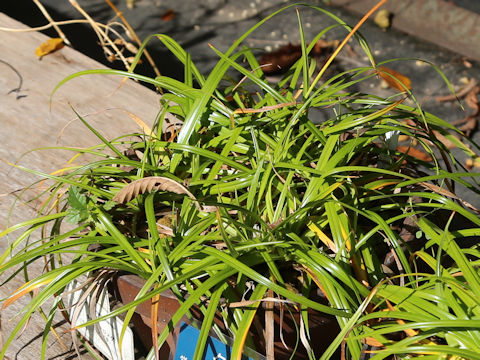
わが国の本州、中部地方以北から北海道、それに千島列島やサハリン、朝鮮半島北部、中国東北部、ウスリー地方に分布しています。高山の湿った草地に生え、高さは15~40センチになります。葉は線形で短く、ほとんどが根生します。8月から10月ごろ、花茎をだして、先端に黒色の小穂を2~4個つけます。果実は倒卵形の痩果です。別名で「みやまわたすげ(深山綿菅)」とも呼ばれます。環境省レッドリストでは、絶滅危惧Ⅱ類 (VU) に分類されています。中国語では「佛焔苞藨草(fo yan bao biao cao)」と呼ばれます。 韓国語では「ファンセゴレンイ(황새고랭이)」です。これは「コウノトリ(ファンセ: 황새)」+「スゲ(コレンイ: 고랭이)」の合成語です。ここでの「ファンセ」はひとつの接頭語、「コレンイ」は湿った水辺に生える草を意味しています。 |
|
|
カヤツリグサ科ホタルイ属の多年草で、学名は Scirpus maximowiczii。英名はありません。 |
|
|
The "Takane-kuro-suge" (Scirpus maximowiczii) belongs to Cyperaceae (the Sedge family). It is a perennial herb that is distributed from the Chubu region of Honshu northward to Hokkaido in Japan, as well as the Kuril Islands, Sakhalin, northern Korea, northeastern China, and the Ussuri region. It grows in moist alpine meadows, reaching heights of 15 to 40 cm. The leaves are linear and short, mostly basal. From August to October, it produces a scape bearing 2 to 4 small black spikelets at its tip. The fruit is an obovate achene. It is also called "Miyama-wata-suge". It is classified as Vulnerable (VU) on the Ministry of the Environment Red List. It is called "佛焔苞藨草" (fo yan bao biao cao) in Chinese. In Korean, it's called "hwang-sae-go-raeng-i" (황새고랭이). This is a compound word consisting of "stork" (hwang-sae: 황새) + "sedge" (go-raeng-i: 고랭이). Here, "hwang-sae" is a prefix, and "go-raeng-i" refers to grass that grows in damp, waterside areas. |
|
|
[上・中1~2] 長野県白馬村北城「八方尾根」にて、2006年08月25日撮影。 [中3・下] 北海道札幌市中央区「北海道大学植物園」にて、2026年09月30日撮影。 |
|
|

|
Shu Suehiro shu@botanic.jp |
|