
|
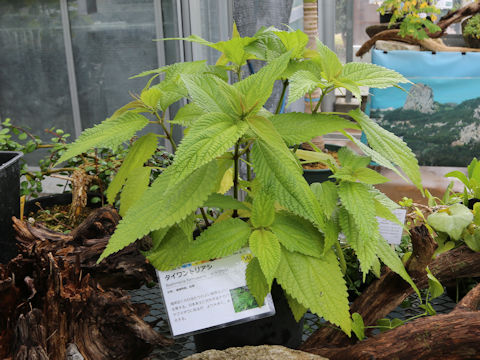
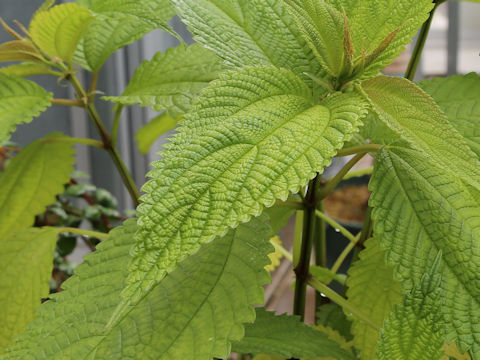
The Formosan false-nettle (Boehmeria formosana) belongs to Urticaceae (the Nettle family). It is a perennial herb that is distributed throughout Japan's Nansei Islands -including Yakushima and Tanegashima- as well as Amami Oshima and Tokunoshima in the Amami Islands, Okinawa Island in the Okinawa Islands, Ishigaki Island in the Yaeyama Islands, and in Taiwan and southeastern China. It grows in lowland forests and reaches a height of 50 to 100 cm. The leaves are ovate to lanceolate, papery in texture, serrated along the margins, and arranged in opposite pairs. From July to around October, it produces panicles in the leaf axils, bearing numerous small, pale yellowish-white flowers. It is monoecious, with female inflorescences on the upper part of the stem and male inflorescences on the lower part. The fruit is an obovate achene. Unlike the basic species, "Nagaba-yabumao" (a triploid that reproduces asexually through agametophyte), this species is diploid and reproduces sexually. It is classified as Vulnerable (VU) in the Ministry of the Environment's Red List. It is called "台灣苧麻" in Taiwanese Chinese and "海島苧麻" (hai dao zhu ma) in Chinese.
|


 たいわんとりあし (台湾鳥足)

 shu@botanic.jp