
|

|
 ちしまぜきしょう (千島石菖) |
[Index]
[Back]
|
|
|
     |
|

|
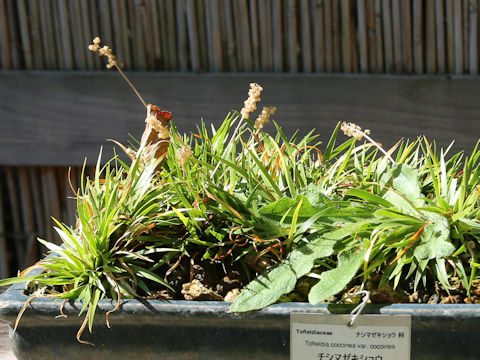
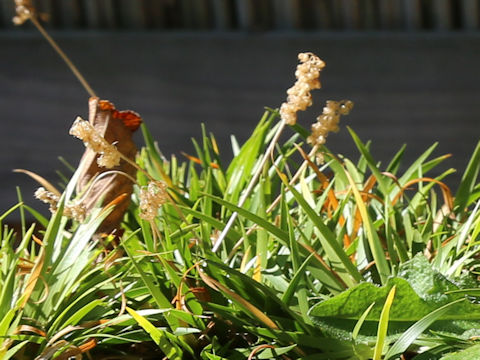
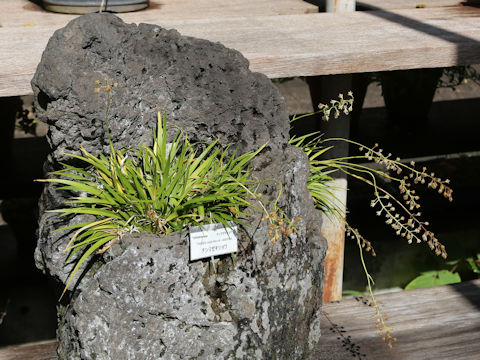
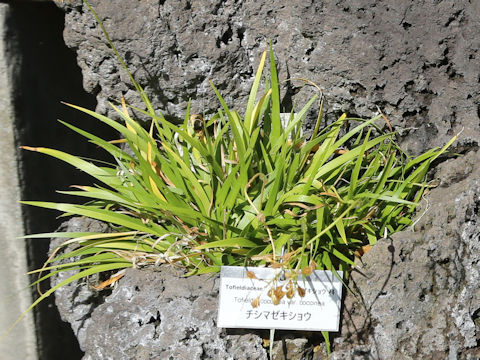
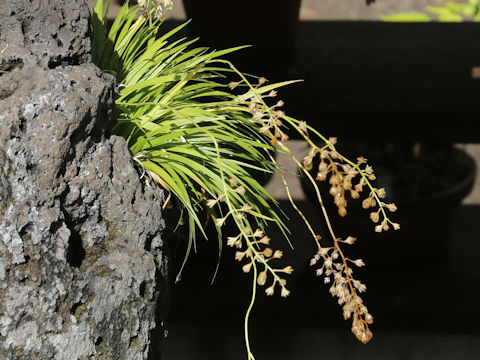
わが国の本州、中部地方以北から北海道、それに朝鮮半島北部から中国北部、千島列島やサハリン、カムチャツカ半島、シベリア、アラスカ、カナダに広く分布しています。高山帯の岩礫地に生え、高さは5~15センチになります。葉は根生し、剣形で先端は鋭くとがり、縁は細かい突起がありざらつきます。7月から8月ごろ、花茎を伸ばして短い総状花序をだし、数個から10数個の小さな花を咲かせます。花被片は長楕円形で白色、かすかに紫色を帯びます。別名で「くろみのいわぜきしょう(黒実の岩石菖)」と呼ばれます。中国語では「長白岩菖蒲(chang bai yan chang pu)」と呼ばれます。 韓国語では「スクンコッチャンポ(숙은꽃장포)」です。これは「伏せた(スクン: 숙은)」+「花菖蒲(コッチャンポ: 꽃장포)」の合成語です。果実が下を向いて実ることから名付けられました。 |
|
|
チシマゼキショウ科チシマゼキショウ属の常緑多年草で、学名は Tofieldia coccinea var. coccinea。英名は Northern asphodel。 |
|
|
The Northern asphodel (Tofieldia coccinea var. coccinea) belongs to the family Tofieldiaceae. It is an evergreen herb that is widely distributed from the Chubu region and northward on Honshu to Hokkaido in Japan, as well as from the northern Korean Peninsula to northern China, the Kuril Islands, Sakhalin, the Kamchatka Peninsula, Siberia, Alaska, and Canada. It grows on rocky scree slopes in alpine zones and reaches a height of 5 to 15 cm. The leaves are basal, sword-shaped with sharply pointed tips, and have fine projections along the margins, giving them a rough texture. From around July to August, the plant extends a flower stalk bearing a short raceme, producing several to over ten small flowers. The perianth segments are oblong and white, with a faint purplish tint. It is also known as "Kuromi-no-iwa-zekisho". It is called "長白岩菖蒲" (chang bai yan chang pu) in Chinese. In Korean, it's called "suk-eun-kkot-chang-po" (숙은꽃장포). This is a compound word formed from "face down" (suk-eun: 숙은) and "flowering iris" (kkot-chang-po: 꽃장포). It was named because its fruit grows facing downward. |
|
|
北海道札幌市中央区「北海道大学植物園」にて、2026年09月30日撮影。 |
|
|

|
Shu Suehiro shu@botanic.jp |
|