
|

|
 つきぬきおとぎり (突抜弟切)
|
[Index]
[Back]
|
|
|
    |
|

|
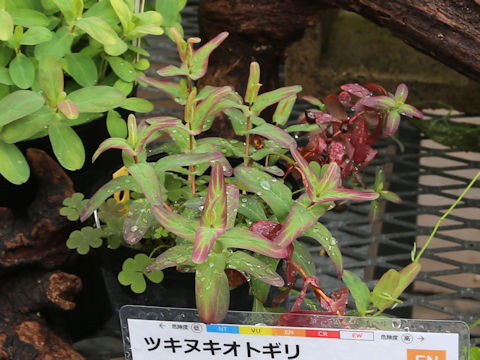
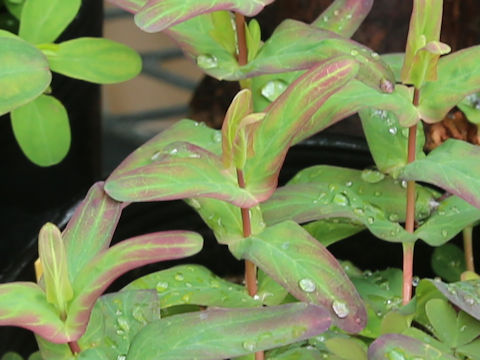
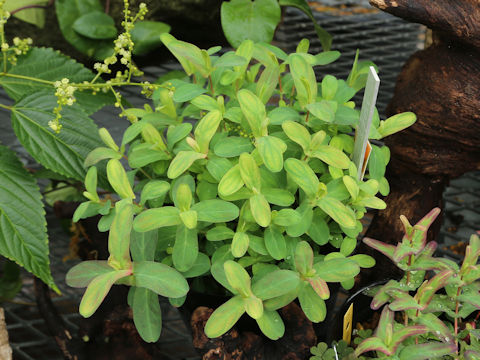
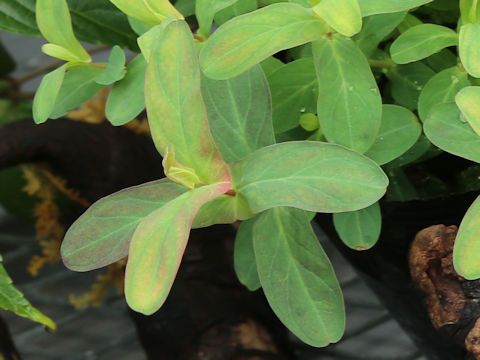
わが国の四国の高知県から九州、屋久島、種子島、トカラ列島、奄美大島、徳之島、それに台湾や中国の中部・南部、インドシナ半島、インドに分布しています。山地の湿り気のある場所に生え、高さは20~100センチになります。茎は直立して上部で分枝します。葉は広披針形から楕円形で、対生する葉は基部で広く合着して、その中央を茎が貫いた形になっています。また葉には多くの明点が入り、縁には黒点が並びます。6月から7月ごろ、茎頂や枝先に、鮮黄色の花を集散状に咲かせます。果実は卵状から卵状円錐形の蒴果です。環境省のレッドブックでは絶滅危惧IB類(EN)に指定されています。台湾華語では「元寶草」、中国語では「元宝草(yuan bao cao)」と呼ばれます。 |
|
|
オトギリソウ科オトギリソウ属の多年草で、学名は Hypericum sampsonii。英名は Sampson's St.John's wort、Sampson's hypericum。 |
|
|
The Sampson's St.John's wort (Hypericum sampsonii) belongs to the famly Clusiaceae. It is a perennial herb that is distributed from Kochi Prefecture on Shikoku to Kyushu, Yakushima, Tanegashima, the Tokara Islands, Amami Oshima, Tokunoshima, as well as Taiwan, central and southern China, the Indochina Peninsula, and India. It grows in moist mountainous areas and reaches a height of 20 to 100 cm. The stem is erect and branches at the top. The leaves are broadly lanceolate to elliptical; the opposite leaves are widely fused at the base, with the stem passing through the center. The leaves also feature numerous light-colored spots, and the margins are lined with black dots. From around June to July, bright yellow flowers bloom in corymbs at the tips of the stems and branches. The fruit is an ovate to ovoid-conical capsule. It is listed as Endangered (EN) in the Ministry of the Environment's Red List. In Taiwanese Chinese, it is called "元寶草", and "元宝草" (yuan bao cao) in Chinese. |
|
|
茨城県つくば市「つくば実験植物園」にて、2026年03月28日撮影。 |
|
|

|
Shu Suehiro shu@botanic.jp
|
|