

|
 つるうめもどき(蔓梅擬) |
|
|
|
-- もっと見る(Show more)--
-- 閉じる(Close) --
|
|
|
|

|
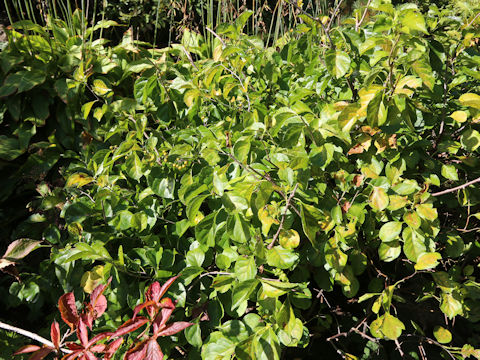
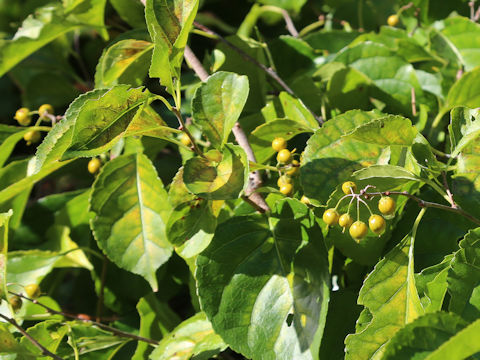
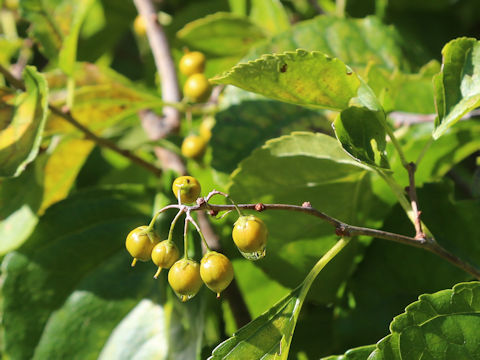
わが国の各地をはじめ、朝鮮半島に分布しています。和名は、モチノキ科の「うめもどき」に似ていることから。5月から6月ごろ、小さな黄緑色の花を葉腋にいっぱい咲かせます。果実は球形で、熟すと3裂して黄色の仮種皮に包まれた赤い種子があられます。これはよく生花の材料に使われます。また樹皮から繊維をとって、糸撚りなどの材料にもするそうです。中国語では「南蛇藤(nan she teng)」と呼ばれます。 韓国語では「ノバクドングル(노박덩굴)」です。これは「ノバク(노박)」+「蔓(トングル: 덩굴)」の合成語です。「ノバク」の由来としては、「ノバクペ(노박폐)」や「ノバン(노방)」が変化したという説が有力です。いずれも茎が道まで伸びて道を塞ぐという意味合いがあります。 |
|
|
ニシキギ科ツルウメモドキ属の落葉低木で、学名は Celastrus orbiculatus (syn. Celastrus orbiculatus var. orbiculatus、Celastrus articulatus)。英名は Oriental bittersweet。 |
|
|
The Oriental bittersweet (Celastrus orbiculatus) belongs to Celastraceae (the Bittersweet family). It is a small deciduous tree that is distributed throughout Japan, as well as the Korean Peninsula and China. Its Japanese name comes from its resemblance to the "Japanese winterberry" (a type of plant in the Holly family). From May to June, the many small yellowish-green flowers come on the axils. The fruits are round. They are splitting open into three and come out red seeds with yellow arils when mature. The fruits are used for flora art and the barks are used as fabric raw materials. It is called "南蛇藤" (nan she teng) in Chinese. In Korean, it's called "no-bak-deong-gul" (노박덩굴). This is a compound word consisting of "no-bak-pye" (노박폐) or "no-bang" (노방) + "vine" (teong-gul: 덩굴). The prevailing theory regarding the origin of "no-bak" is that it evolved from "no-bak-pye" (노박폐) or "no-bang" (노방). In both cases, the implication is that the stems extend all the way to the road and block it. |
|
|
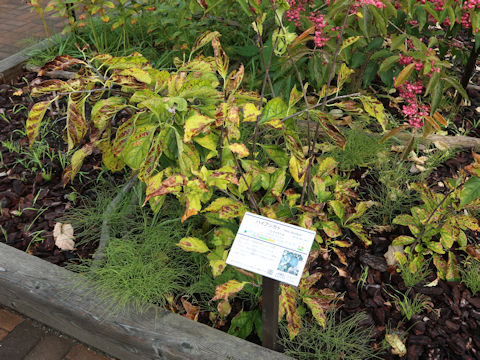
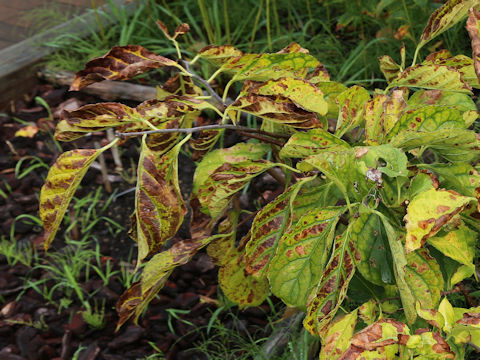
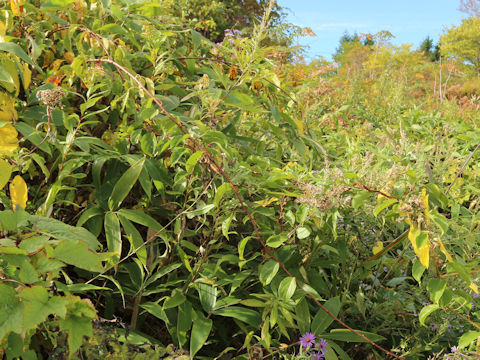
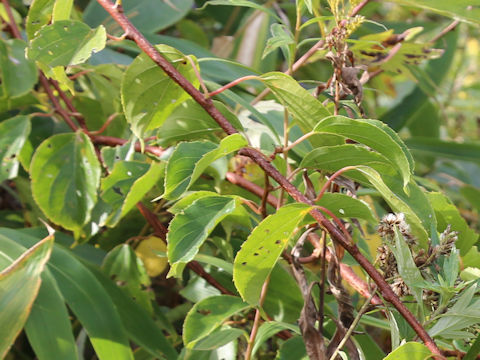
[上・中1] 長野県松本市奈川「白樺峠」にて、2005年06月25日撮影。 [中2] 長野県大鹿村大河原「鳥倉山」にて、2005年09月22日撮影。 [中3・中4] 茨城県神栖市土合北にて、2009年09月09日撮影。 [中5・中6] 愛知県新城市作手田原にて、2006年11月15日撮影。 [中7] 愛知県蒲郡市柏原町「坂野峠」にて、2006年01月27日撮影。 [中8] 長野県長和町和田にて、2008年01月06日撮影。 [中9・中10] 千葉県香取市大角にて、2011年08月18日撮影。 [中11・中12] 茨城県日立市「神峰山」にて、2013年11月30日撮影。 [中13・中14] 宮城県石巻市雄勝町「硯上山」にて、2016年01月16日撮影。 [中15] 宮城県仙台市泉区「泉ヶ岳」にて、2016年06月04日撮影。 [中16・中17] 宮城県川崎町支倉にて、2020年10月20日撮影。 [中18~中22] 宮城県気仙沼市「大森山」にて、2020年11月22日撮影。 [中23~中27] 宮城県七ヶ浜町「湊浜海浜緑地」にて、2021年05月24日撮影。 [中28~中30] 北海道札幌市中央区「北海道大学植物園」にて、2026年09月30日撮影。 [中31・中32] 北海道白老町若草町「ウポポイ」にて、2026年10月01日撮影。 [中33・下] 北海道苫小牧市美沢にて、2026年10月01日撮影。 |


|
|

|
Shu Suehiro shu@botanic.jp |