
|

|
 わだつみのき (海神の木)
|
[Index]
[Back]
|
|
|
     |
|

|
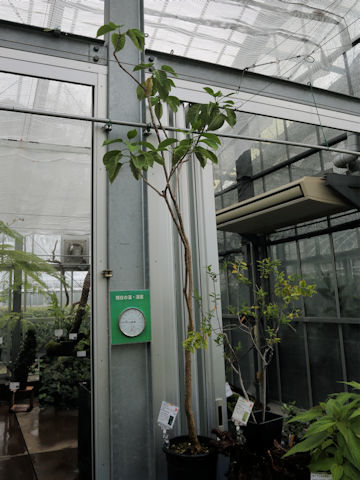
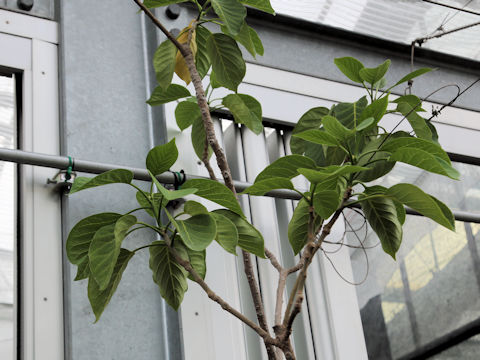
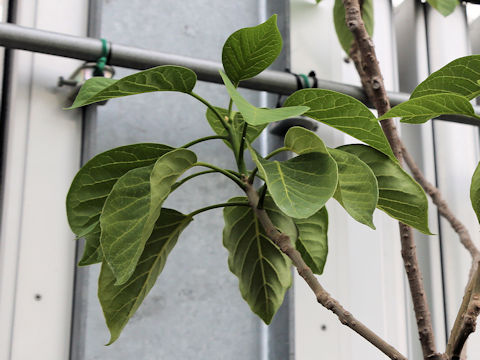
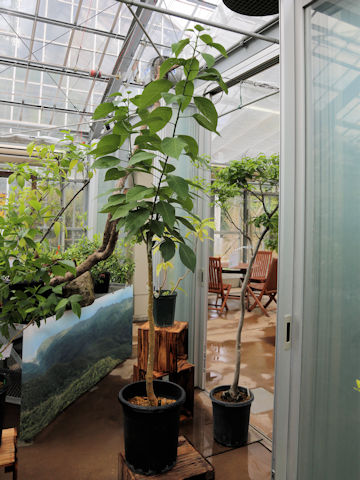
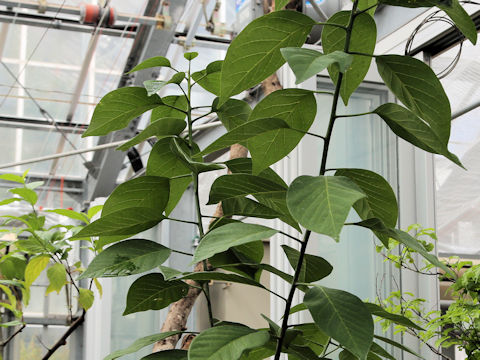
わが国の奄美群島にある奄美大島の固有種です。奄美大島中南部の近海地に生え、高さは10メートルほどになります。現在、確認されているのはわずか20本ほどで、環境省のレットブックでは絶滅危惧IA類(CR)に分類されています。これまでは、八重山群島や台湾に分布する「くさみずき」とされてしましたが、2004年に京都大学の加藤真さんほかの研究チームによって、新種とということが明らかになりました。和名は、奄美出身の歌手、元(はじめ)ちとせさんのヒット曲、「ワダツミの木」に因みます。5月中旬に直径約1センチの白い花を咲かせますが、「くさみずき」に比べて葉や花が大きく、おしべ先端の袋が突き出すなどの特徴があるといいます。「くさみずき」と同じく、木部と葉に抗がん剤の原料となるカンプトテシンを含有しています。 「ワダツミの木」(作詞: 上田現) 赤く錆びた月の夜に 小さな船をうかべましょう うすい透明な風は 二人を遠く遠くに流しました どこまでもまっすぐに進んで 同じ所をぐるぐる廻って 星もない暗闇で さまよう二人がうたう歌 波よ もし 聞こえるなら 少し 今声をひそめて 私の足が海の底を捉えて 砂にふれたころ 長い髪は枝となって やがて大きな花をつけました ここにいるよ あなたが迷わぬように ここにいるよ あなたが探さぬよう 星に花は照らされて 伸びゆく木は水の上 波よ もし 聞こえるなら 少し 今声をひそめて 優しく揺れた水面に 映る赤い花の島 波よ もし 聞こえるなら 少し 今声をひそめて Woo… Woo… Woo… |
|
|
クロタキカズラ科クサミズキ属の落葉小高木で、学名は Nothapodytes amamianus (syn. Mappia amamiana)。英名はありません。 |
|
|
The "Wadatsumi-no-ki" (Nothapodytes amamianus) belongs to Icacinaceae (the White pear family). It is a semi-tall deciduous tree that is an endemic species found on Amami Oshima in Japan's Amami Islands. It grows in coastal areas of central and southern Amami Oshima and reaches a height of about 10 m. Currently, only about 20 trees have been confirmed, and it is classified as Critically Endangered (CR) in the Ministry of the Environment's Red List. Until recently, it was considered to be the same species as "Kusa-mizuki", which is distributed throughout the Yaeyama Islands and Taiwan; however, in 2004, a research team led by Makoto Kato of Kyoto University confirmed that it is a new species. Its Japanese name is derived from the hit song "Wadatsumi no Ki" by Chitose Hajime, a singer from Amami. It blooms white flowers about 1 cm in diameter in mid-May. Compared to "Kusa-mizuki", it is said to have larger leaves and flowers, as well as distinctive features such as protruding sacs at the tips of the stamens. Like "Kusa-mizuki", its wood and leaves contain Camptothecin, a raw material used in anticancer drugs. |
|
|
茨城県つくば市「つくば実験植物園」にて、2026年03月28日撮影。 |
|
|

|
Shu Suehiro shu@botanic.jp
|
|