
|

|
 わらびつなぎ (蕨繋ぎ)
|
[Index]
[Back]
|
|
|
   |
|

|
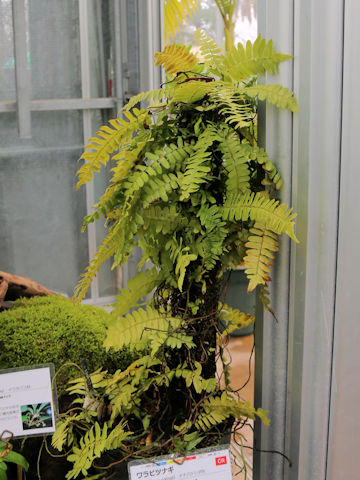
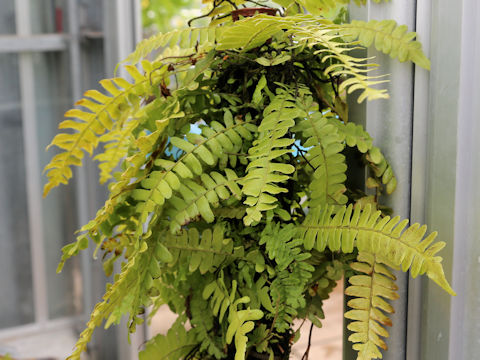
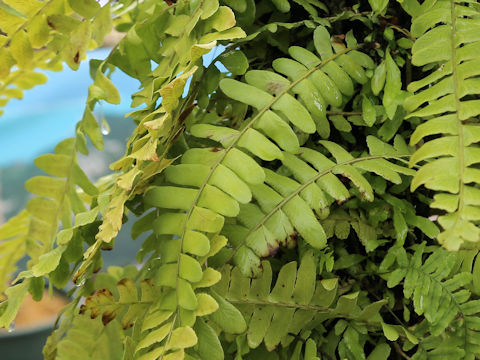
わが国の奄美群島の奄美大島から沖縄群島の沖縄島、八重山群島の石垣島、それに台湾やフィリピン、中国、ベトナム、インドネシア、ポリネシア、インドおよびアフリカに分布しています。山地の岩上や樹幹に生え、高さは20~30センチになります。根茎は針金状で、長く地面を匍匐しツル状に這い上がります。不葉は披針形で1回羽状複葉、長さは30~40センチになります。側羽片は25~35対あり、中軸の両側に互生します。胞子嚢は羽片の中肋と辺縁の間に縦1列に並び、包膜は円腎形です。環境省のレッドブックでは絶滅危惧IA類(CR)に分類されています。台湾華語では「藤蕨」、中国語では「爬樹蕨(pa shu jue)」と呼ばれます。 |
|
|
ナナバケシダ科ワラビツナギ属の常緑シダ類で、学名は Arthropteris palisotii。英名は Lesser creeping fern、Arthropteris fern。 |
|
|
The Lesser creeping fern (Arthropteris palisotii) belongs to the family Tectariaceae. It is an evergreen fern that is distributed from Amami-Oshima in Japan's Amami Islands to Okinawa Island in the Okinawa Islands, Ishigaki Island in the Yaeyama Islands, as well as Taiwan, the Philippines, China, Vietnam, Indonesia, Polynesia, India, and Africa. It grows on rocks and tree trunks in mountainous areas and reaches a height of 20 to 30 cm. The rhizome is wire-like, creeping along the ground for long distances and climbing upward like a vine. The leaves are lanceolate and once-pinnately compound, reaching a length of 30-40 cm. There are 25-35 pairs of lateral pinnae, arranged alternately on either side of the midrib. The sori are arranged in a single vertical row between the midrib and the margin of the pinnae, and the indusia are reniform. The Ministry of the Environment's Red List classifies it as Critically Endangered (CR). In Taiwanese Chinese, it is called "藤蕨", and "爬樹蕨" (pa shu jue) in Chinese. |
|
|
茨城県つくば市「つくば実験植物園」にて、2026年03月28日撮影。 |
|
|

|
Shu Suehiro shu@botanic.jp
|
|