
|

|
 やまはんのき (山榛の木)
|
[Index]
[Back]
|
|
|
     |
|

|
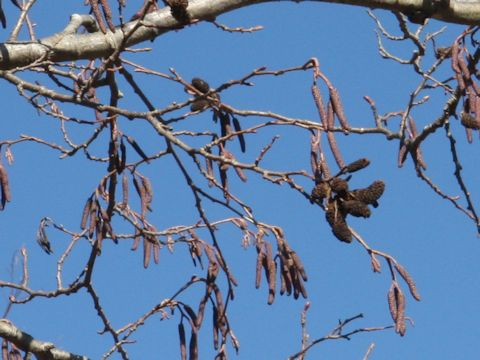
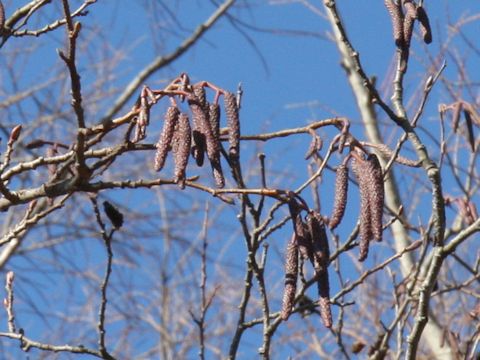
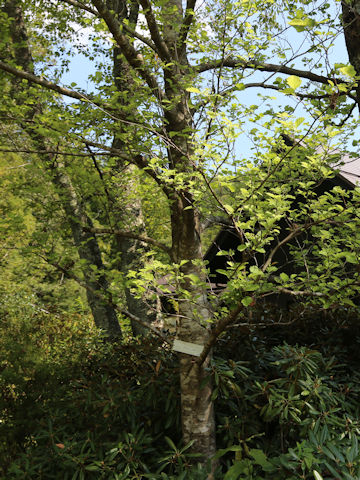
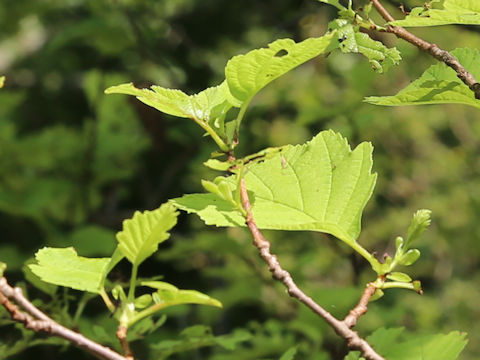
わが国の各地をはじめ、朝鮮半島や中国、サハリン、カムチャッカ半島、東シベリアに分布しています。丘陵から山地に生え、高さは10~20メートルになります。葉は広卵形で縁には欠刻状の重鋸歯があります。葉脈は明瞭で窪みます。4月ごろ、葉の展開前に花序を下垂させます。雌花序は雄花序の下につきます。果実は楕円形で黒褐色に熟します。葉や枝、冬芽など、全体にほとんど毛がありません。中国語では、ケヤマハンノキと同じく「遼東榿木(liao dong qi mu)」と呼ばれます。韓国語では「ムルゲムナム(물갬나무)」です。茶色や黒色の染料として広く使われていたことから、「水(물)」+「染料(갬)」+「木(나무)」という意味の合成語です。 |
|
|
カバノキ科ハンノキ属の落葉高木で、学名は Alnus hirsuta var. sibirica。英名は Siberian alder。 |
|
|
The Siberian alder (Alnus hirsuta var. sibirica) belongs to Betulaceae (the Birch family). It is a tall deciduous tree that is distributed throughout various regions of Japan, as well as on the Korean Peninsula, in China, on Sakhalin, the Kamchatka Peninsula, and in Eastern Siberia. It grows in hilly to mountainous areas and reaches a height of 10 to 20 m. The leaves are broadly ovate with deeply serrated margins. The leaf veins are distinct and sunken. Around April, before the leaves unfurl, it produces pendulous inflorescences. The female inflorescences appear below the male ones. The fruit is elliptical and ripens to a blackish-brown color. The entire plant -including the leaves, branches, and winter buds- is almost entirely hairless. In Chinese, it is called "遼東榿木" (liao dong qi mu), the same as the Manchurian alder. In Korean, it is known as "Mul-gaem-namu" (물갬나무). It is a compound word meaning "water: 물" + "dye: 갬" + "wood: 나무". |
|
|
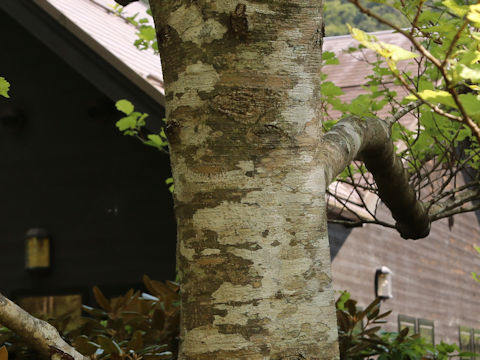
[上・中1] 茨城県つくば市「つくば実験植物園」にて、2013年01月19日撮影。 [中2~3・下] 宮城県仙台市太白区秋保町馬場「秋保大滝植物園」にて、2026年08月25日撮影。 |
|
|

|
Shu Suehiro shu@botanic.jp
|
|