
|

|
 よなぐにのしらん (与那国熨斗蘭)
|
[Index]
[Back]
|
|
|
   |
|

|
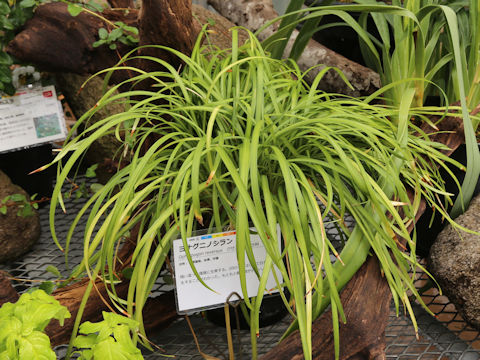
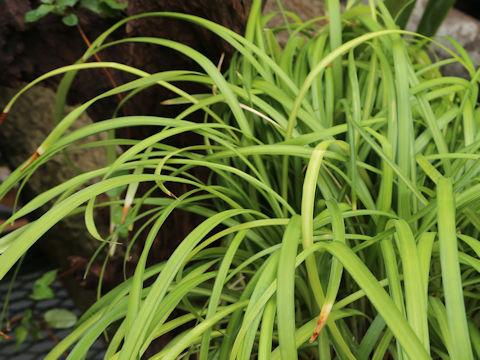
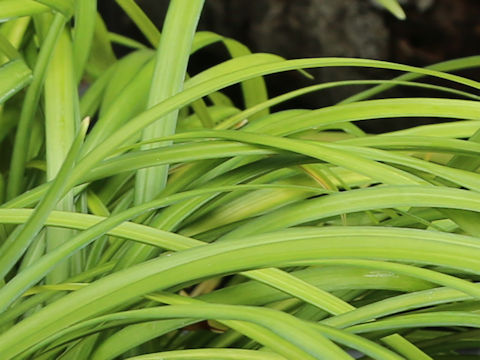
わが国の八重山群島にある与那国島、それに台湾や中国南部の広西チワン族自治区や海南島に分布しています。森林や小川沿いなどに生え、高さは15~30センチになります。葉は線形で、長さ40~55センチ、束生します。8月から10月ごろ、花茎をだして、茎頂に白色の花を疎らに咲かせます。花弁のように見える部分は萼片で、やや反り返り下向きに咲きます。葯が黄色なのが特徴です。花後にできる丸く青紫色の果実のように見えるのは種子です。環境省のレッドブックでは絶滅危惧IA類(CR)に分類されています。台湾華語では「高節沿階草」、中国語では「高節沿階草(gao jie yan jie cao)」と呼ばれます。 |
|
|
ユリ科ジャノヒゲ属の常緑多年草で、学名は Ophiopogon reversus。英名はありません。 |
|
|
The "Yonaguni-noshi-ran" (Ophiopogon reversus) belongs to Liliaceae (the Lily family). It is a perennial evergreen herb that is found on Yonaguni Island in Japan's Yaeyama Islands, as well as in Taiwan, the Guangxi Zhuang Autonomous Region and Hainan Island in southern China. It grows in forests and along streams, reaching a height of 15 to 30 cm. The leaves are linear, 40 to 55 cm long, and grow in clusters. From August to October, it produces a flower stalk and bears sparse white flowers at the tip. The parts that appear to be petals are actually sepals, which curve slightly backward and face downward. A distinctive feature is the yellow anthers. The round, bluish-purple structures that appear to be fruits after flowering are actually seeds. The Ministry of the Environment's Red List classifies it as Critically Endangered (CR). It is called "高節沿階草" in Taiwanese Chinese, and "高節沿階草" (gao jie yan jie cao) in Chines. |
|
|
茨城県つくば市「つくば実験植物園」にて、2026年03月28日撮影。 |
|
|

|
Shu Suehiro shu@botanic.jp
|
|