

|
 ゆきざさ (雪笹) |
|
|
|
-- もっと見る(Show more)--
-- 閉じる(Close) --
|
|
|
|

|
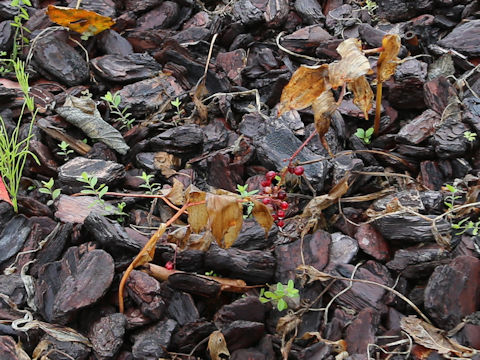
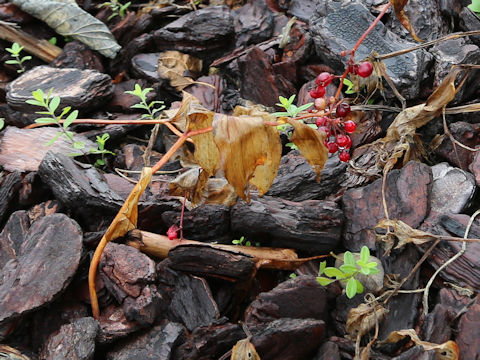
わが国の各地をはじめ、台湾や朝鮮半島、中国、アムール・ウスリー地方に分布しています。山地の林内に生え、高さは20~70センチになります。茎の上部は斜上し、楕円形の葉が互生します。葉や茎には毛が多く生えています。5月から7月ごろ、円錐形の総状花序をだし、小さな白い花を咲かせます。果実は液果で秋に赤く熟します。和名は、白い花を雪に、葉を「ささ」に喩えたものです。台湾華語では「鹿藥」、中国語では「鹿葯(lu yao)」と呼ばれます。 韓国語では「プルソムデ(풀솜대)」または「チジャンボサル(지장보살)」です。「ブルソムデ」は、草でありながら「ハチク(ソムデ: 솜대)」に似ていることから。また「チジャンボサル」とは「地蔵菩薩」のことで、食糧難の時期に若芽を山菜として食べたことから、衆生を救済する草という意味で付けられました。 |
|
|
ユリ科ユキザサ属の多年草で、学名は Smilacina japonica (syn. Maianthemum japonicum)。英名はありません。 |
|
|
The "Yuki-zasa" (Smilacina japonica) belongs to Liliaceae (the Lily family). It is a perennial herb that is distributed throughtout Japan, as well as Taiwan, the Korean Peninsula, China, Amur and Ussuri. This herb grows in montane woodlands and can reach 20-70 cm in height. The upper stem grows side-upward, the leaves are elliptic and alternate, The stem and leaves have numerous hairs. The conical raceme is borne and blooms small white flowers from May to July. The fruits are berries and ripen red in fall. The Japanese name is derived from the metaphor of the white flowers as snow and the leaves as "sasa". In Taiwanese Chinese, it is called "鹿藥" and in Chinese "鹿葯" (lu yao). In Korean, it's called "pul-som-dae" (풀솜대) or "chi-jang-po-sal" (지장보살). "pul-som-dae" is named for its resemblance to "Hachiku, Henon bamboo" (som-de: 솜대), even though it is a grass. Additionally, "chi-jang-po-sal" refers to "Jizo Bosatsu" (Ksitigarbha Bodhisattva); the name was given to this plant to signify that it is a "grass that saves all sentient beings", as its young shoots were eaten as wild greens during times of food shortages. |
|
|
[上] 長野県伊那市西春近「かんてんぱぱガーデン」にて、2007年05月08日撮影。 [中5] 同上にて、2006年04月04日撮影。 [中1] 大阪市鶴見区「咲くやこの花館」にて、2006年04月25日撮影。 [中2・中3] 大阪府河内長野市滝畑「南葛城山」にて、2006年05月15日撮影。 [中4] 長野県小谷村中土「雨飾高原」にて、2006年08月02日撮影。 [中6~中8] 群馬県渋川市伊香保にて、2010年05月16日撮影。 [中9・中10] 群馬県片品村戸倉「尾瀬ヶ原」にて、2012年06月10日撮影。 [中11・中12] 茨城県北茨城市関本町「和尚山」にて、2012年09月22日撮影。 [中13・中14] 福島県田村市滝根町「大滝根山」にて、2013年09月28日撮影。 [中15~中17] 茨城県つくば市「筑波山」にて、2014年04月12日撮影。 [中18~中20] 福島県北塩原村「猫魔ヶ岳」にて、2014年06月14日撮影。 [中21・中22] 栃木県那須塩原市板室にて、2014年08月15日撮影。 [中23・中24] 茨城県石岡市「筑波山」にて、2014年09月13日撮影。 [中25・中26] 福島県檜枝岐村「燧ヶ岳」にて、2014年09月20日撮影。 [中27~中29] 山形県小国町小玉川にて、2018年07月06日撮影。 [中30・中31] 同上にて、2019年05月22日撮影。 [中32~中35] 岩手県雫石町「犬倉山」にて、2019年07月11日撮影。 [中36] 岩手県八幡平市「源太ヶ岳」にて、2021年07月24日撮影。 [中37・中38] 福島市松川町「水原地区くまがいそう自生地」にて、2023年05月04日撮影。 [中39・下] 北海道白老町若草町「ウポポイ」にて、2026年10月01日撮影。 |


|
|

|
Shu Suehiro shu@botanic.jp |